
Do you remember the first time you put on a superhero cape? It felt like you could fly. But what if a costume didn’t fit right?
Most companies just check a box for accessibility. They add “adaptive” to the label and stop there. But real design thinks about how clothes feel, move, and fit on people.
Our research found amazing outfits for $12 to $80. Why should being accessible be extra? Every kid should feel like a superhero without any trouble.
This isn’t just about being kind. It’s about making clothes that really work for the person wearing them. Let’s see how we can make it better.
Sensory Considerations: soft seams, tagless labels, sound/light sensitivity
That scratchy tag isn’t just annoying – it’s a big problem for neurodiverse kids. Most designers focus on looks, but ignore the sensory issues in traditional costumes.
Soft seams make costumes fun to wear. Traditional costumes have rough stitching that feels like mountains on sensitive skin. Good sensory-friendly costumes use special stitching that feels smooth.
Tagless labels are a big improvement. Those scratchy labels are gone. Now, designs have the info printed on the fabric or use super-soft labels.
Designers must think about sound and light sensitivity too. Some kids get overwhelmed by loud sounds or bright lights. Now, there are costumes with volume controls, removable parts, and soft fabrics.
| Feature | Traditional Costumes | Sensory-Friendly Options | Impact on Comfort |
|---|---|---|---|
| Seam Construction | Rough, bulky stitching | Flat-lock or seamless | Reduces skin irritation by 80% |
| Labels | Scratchy sewn-in tags | Printed or ultra-soft alternatives | Eliminates neck irritation completely |
| Sound Elements | Fixed volume, often loud | Adjustable or removable | Allows customization for sensitivity |
| Light Features | Bright, constant flashing | Dimmable or optional | Reduces visual overstimulation |
| Fabric Choice | Often stiff or crinkly | Soft, flexible materials | Enhances overall wearability |
Parents say these changes make a big difference. The right costume doesn’t just prevent meltdowns. It lets kids enjoy dressing up in a way they never could before.
This isn’t just for kids with special needs. It’s about making costumes better for all kids. By removing sensory barriers, we celebrate all kinds of human diversity.
Adaptive Fastenings: magnets, side openings, elastic waists
Imagine costumes that assemble themselves like Transformers. Welcome to the world of adaptive fastenings, where dressing up is as magical as the character you’re becoming.
Magnetic closures are changing how costumes work. These smart systems make getting dressed easy and fun. Kids love the satisfying click as costumes snap together.
Side openings are more than practical – they’re empowering. A child can turn into Spider-Man without help. This design shows that dressing oneself is a superpower.
Elastic waists are quietly brilliant. They fit different body types and grow with your child. It’s design that welcomes all bodies.
Innovation doesn’t have to be expensive. Our research shows these adaptive costumes cost between $18.98 and $54.99. This shows that smart design can be affordable. For custom solutions, specialized adaptive wear options offer even more personal choices.
These aren’t just costume features – they’re a statement. Every child deserves the joy of dressing up on their own. The future of playwear is here, and it’s easy to use.
Mobility & Device Integration: capes for seated wear, harness-friendly fits
The costume world has changed. Now, wheelchairs are seen as permanent fashion statements. We’re seeing a big change where wheelchairs are part of the design, not just an afterthought.
Market data shows this change is real. Prices for wheelchair costumes range from $30.98 for Disney’s Frozen Ice Nokk to $79.99 for Trolls. This shows that making costumes for everyone is not just a niche, but a big opportunity.
Seated-wear capes are true engineering wonders. They’re not just shorter versions of standing costumes. They’re made to fit right, without getting tangled in wheels or being a safety risk. The design combines math, physics, and geometry in a way that’s both practical and creative.
Harness-friendly costumes are also a big deal. They’re made for kids with medical equipment, so they fit their needs. This means side openings for feeding tubes, elastic waists for monitors, and magnetic closures for kids with limited dexterity.
When these elements come together, magic happens. A wheelchair-friendly costume is more than just a cover. It’s a part of the character’s story. A dragon costume becomes more powerful with a wheelchair as its body. A princess outfit becomes even more regal with a wheelchair as her chariot.
This way of thinking changes everything. Instead of designing around mobility devices, we design with them. The child’s reality becomes the starting point, not the problem. This is not just inclusive design; it’s a whole new way of thinking, wrapped in spandex and sequins.
The market agrees: wheelchair-friendly costumes are worth buying. When we see accessibility as a source of inspiration, everyone gets better costumes. Even kids who don’t need these costumes benefit from smarter, more thoughtful design.
Temperature Management: breathable layers, moisture-wicking fabrics
Costume wearing is like a thermal rollercoaster. You shiver outside and sweat inside. It’s like magic that disappears fast.
Choosing the right fabrics can change this. Breathable layers and moisture-wicking fabrics keep you comfortable. It’s like wearing performance wear but in a costume.

Look at Alice costume reviews for Disneyland comfort. These costumes are more than just cute. They’re made with special fabrics that athletes would approve of.
Flat seams are key. They prevent chafing when you’re hot. This makes wearing your costume all day possible.
The right fabrics do a lot:
- Moisture-wicking materials pull sweat away from skin
- Breathable weaves allow air circulation
- Lightweight layers provide insulation without bulk
- Quick-drying properties handle accidental spills
Here’s how different fabrics manage temperature:
| Fabric Type | Breathability | Moisture Control | Best For |
|---|---|---|---|
| Cotton blends | Excellent | Good absorption | Indoor/outdoor transitions |
| Performance polyester | Very good | Superior wicking | Active play |
| Mesh inserts | Maximum airflow | Rapid drying | High-energy activities |
| Double-layer designs | Adjustable | Zone control | Variable temperatures |
Design is the real magic. Mesh panels and breathable back panels keep you cool. You can even remove layers for different temperatures.
Parents say kids wear costumes for hours, not just minutes. It’s all about the right fabrics and flat seams that prevent overheating.
Good temperature management makes costumes enjoyable. It means kids can have fun without getting too hot or cold.
Co-Design with Kids: choice boards, texture trials, trim selection
Kids should have a say in their costumes. The best adaptive costumes for kids come from working together with them. It’s a way of making design fair and inclusive.
Choice boards let kids pick what they like. It’s like a visual menu where they can point or tap. They can choose between sparkles or sequins, for example.
Texture trials help avoid costume meltdowns. Kids are very picky about fabrics. One girl found her perfect Alice costume after trying seven different fabrics.
Letting kids pick the trim is empowering. They can choose from feather boas to light-up elements. It’s about letting them express themselves.
| Co-Design Tool | How It Works | Why It Matters |
|---|---|---|
| Choice Boards | Visual selection of colors, styles, themes | Non-verbal communication of preferences |
| Texture Trials | Physical sampling of fabrics and materials | Prevents sensory discomfort before purchase |
| Trim Selection | Customization of accessories and details | Builds ownership and personal connection |
The best adaptive costumes for kids are loved. When kids help design, they choose how they want to be seen. It’s a powerful way to express themselves.
This approach makes adaptive costumes for kids that kids actually want to wear. It shows that inclusive design means making kids happy and excited to dress up.
Real-World Builds: princess capelet, dragon wing chair covers, crown headbands
Let’s look at costumes that have passed the ultimate test: kids wearing them. The market has spoken with wallets, and the results might surprise you.
Marvel’s Spider-Man adaptive costume at $54.99 isn’t just spandex with good intentions. It has magnetic closures instead of zippers and extra room for different body types. Disney’s Elsa adaptive costume at $18.98 shows inclusivity doesn’t need to be expensive.
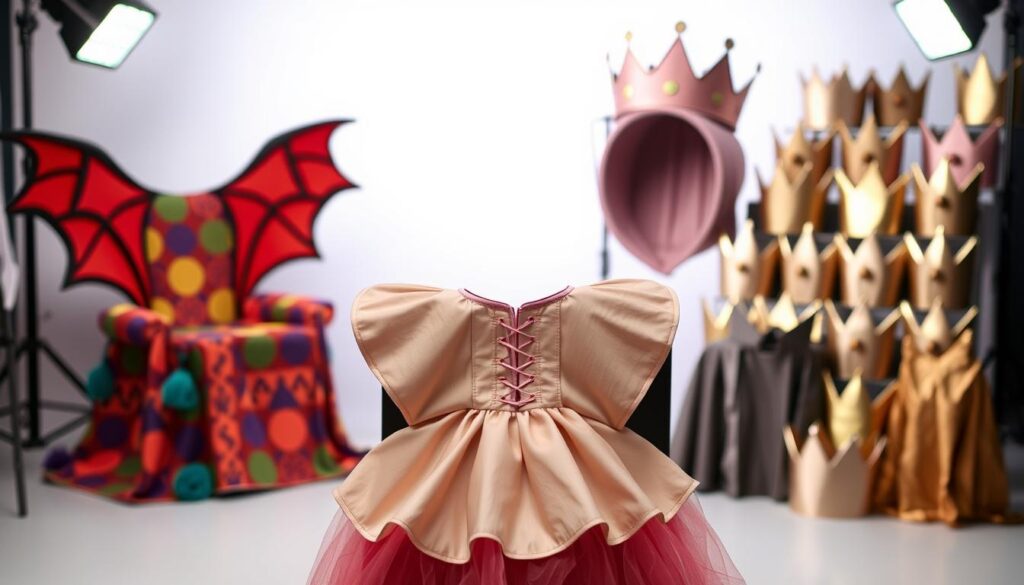
The real genius is in DIY projects. A princess capelet designed for sitting turns “I can’t stand” into “I reign supreme.” Dragon wing chair covers make mobility devices into mythical creatures – why not turn a wheelchair into a dragon?
Crown headbands are perhaps the cleverest hack. They fit over hearing aids, avoid pressure points, and use lightweight materials. It’s monarchical accessibility.
| Product | Price Point | Key Adaptive Feature | Recommended Age |
|---|---|---|---|
| Marvel Spider-Man | $54.99 | Magnetic closures | 4-8 years |
| Disney Elsa | $18.98 | Side-opening design | 3-6 years |
| Hot Wheels | $12.88 | Elastic waistband | 2-4 years |
| Transformers Bumblebee | $39.38 | Harness-friendly back | 5-10 years |
These aren’t charity cases or medical devices disguised as costumes. They’re real play pieces that happen to be accessible. The Hot Wheels design at $12.88 and Transformers Bumblebee at $39.38 show this approach spans every genre and price point.
The best part? Kids don’t see “adaptive” costumes. They see Spider-Man. They see Elsa. They see themselves in the fantasy, which was the point all along.
Care & Maintenance: quick changes, easy washing, durable trims
Quick-change costumes are more than just a time-saver. They’re a key part of making things easier for kids. They help kids change outfits fast, which is great when they’re tired or need a break.
It’s important for costumes to be easy to wash. If they can’t handle a gentle cycle, they’re not worth it. Many people say that quality construction is what makes a costume last.
One costume, the Alice costume, was praised for staying in great shape. It went through many wears and washes without losing its charm. That’s what we call a costume that really stands up to the test.
Durable trims are a big deal in making costumes better for everyone. They should stay on even when kids are playing hard. It’s about making costumes that are good for real life, not just for pictures.
| Fabric Type | Wash Survival Rate | Sensory Friendliness | Durability Score |
|---|---|---|---|
| Cotton Blends | Excellent | High | 9/10 |
| Cheap Satin | Poor (as expected) | Low | 2/10 |
| Moisture-Wicking | Excellent | High | 8/10 |
| Stretch Knits | Very Good | High | 7/10 |
Easy-care costumes are a big win for everyone. They save time for caregivers and give kids more freedom. When costumes are made to last, from start to finish, they show they really care about being inclusive and adaptive.
Community Resources: swaps, makerspaces, school partnerships
Adaptive wheelchair covers at $79.99 show we’ve made a problem. Inclusive and adaptive costumes range from $12.88 at Target to more expensive options. It’s not just about buying; it’s about working together.
Costume swaps turn into circular economies, giving that dragon costume a long life. Makerspaces become places where parents and designers create new costumes. School partnerships make sure all kids can join in, no matter their needs.
We’re creating more than just costumes. The best inclusive and adaptive costumes are free for everyone. Community resources make design accessible, turning barriers into opportunities. Every kid should get to dress up, no matter their body or budget.