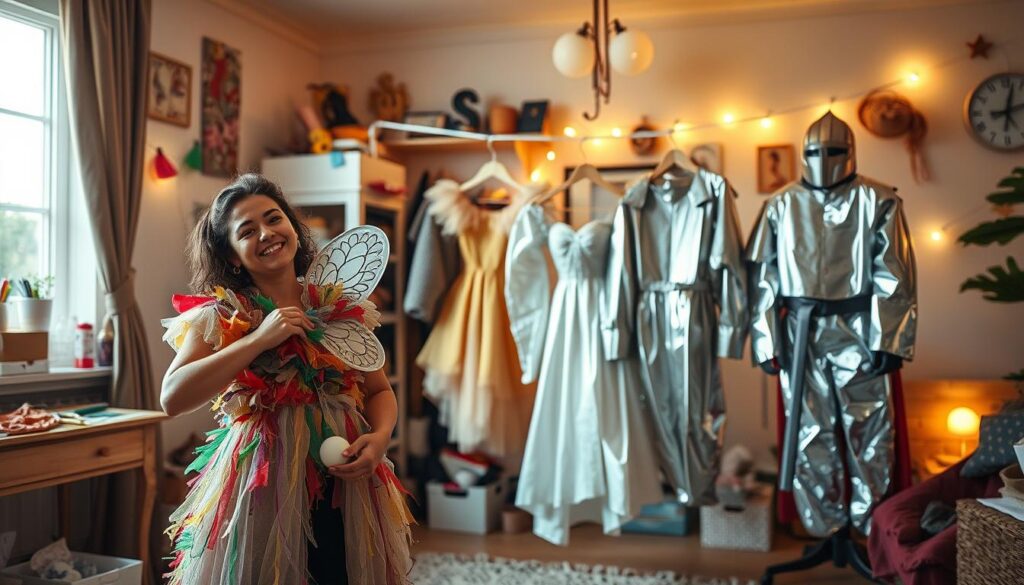

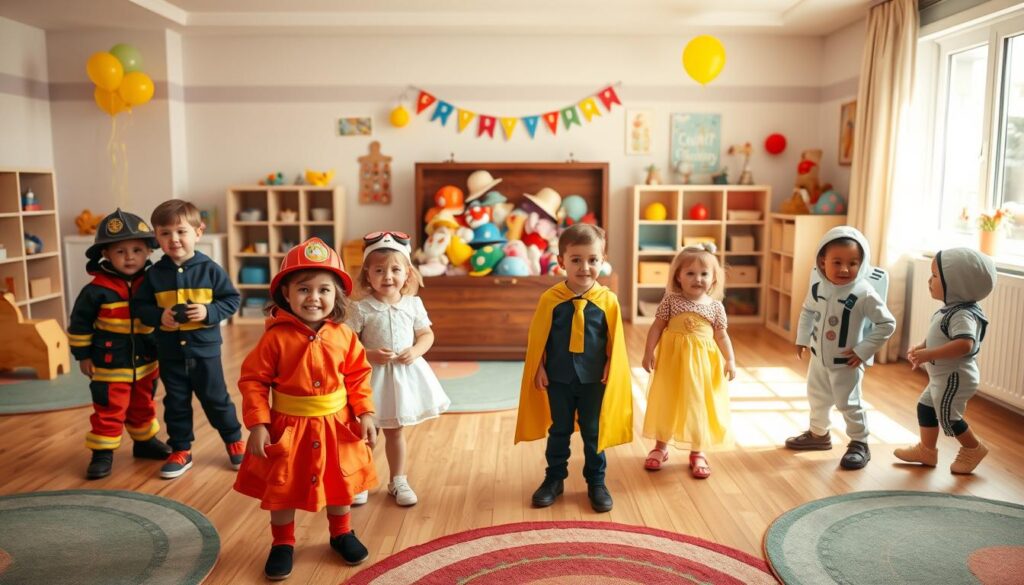
Choosing dress-up items isn’t just about finding the shiniest tiara. It’s about developmental stagecraft. It’s like giving your child’s imagination a rating system.
For 1-2 year-olds, play is all about symbols. A hairbrush is a microphone, and a cardboard tube is Excalibur. This object substitution is a big step in their learning.
By ages 2-3, simple role play starts. Safety is key here. That’s why Safe Dress-Up Ideas for Home are so important. No small buttons or long capes to avoid choking hazards.
As children grow, so does their play. From complex scenarios for 3-5 year-olds to rule-based games for 6+, we’re not just giving costumes. We’re giving them the tools to create their own stories.
DIY costume tips
The costume aisle is a symbol of consumer guilt, not creative play at home. It’s like fast food for your imagination—quick, empty, and soon forgotten.
True pretend play is all about DIY. It’s about using found objects and creative hacks. Research from the American Academy of Pediatrics shows that imaginative, unstructured play supports cognitive development, creativity, and emotional growth in children.
I used to feel like I was failing because I didn’t create elaborate play worlds. But then I saw my kids turn a cardboard box and a marker into a spaceship, a castle, and a time machine. They did it all before lunch. The secret? Prop boxes.
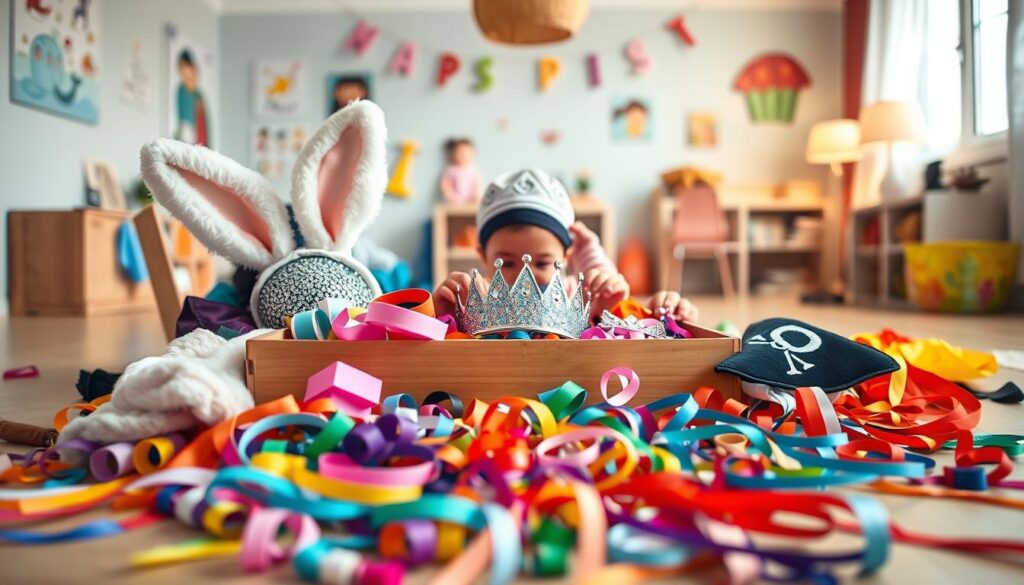
Early childhood educators know a thing or two. A “Restaurant” prop box isn’t just a mini stove. It’s a tablecloth, napkins, a notepad for orders, and play dough for food.
You’re not running a catering service. You’re setting the stage for improvisational theater. This idea is captured in lists of “not-so-extravagant pretend play ideas.” Think DIY Detective Dress Up or a Pretend Play Garden.
The key is to think in themes, not toys. A “Veterinarian” kit is a stuffed animal, a ruler (stethoscope), and bandaids. A “Space Explorer” is a cardboard helmet and a backpack with “provisions.”
The goal is to give the prompt—the word “detective,” the idea of a “garden”—and then step back. Your child’s imagination will fill in the details better than any studio.
To make this clear, here’s a breakdown of how simple prop boxes lead to complex play. This table isn’t a shopping list; it’s a prompt generator.
| Theme | Core Props | Imaginative Prompt | Real-World Skill |
|---|---|---|---|
| Restaurant | Tablecloth, napkins, notepad, play dough | Taking orders, serving customers, managing a menu | Communication, social interaction |
| Veterinarian | Stuffed animal, ruler (stethoscope), bandaids | Diagnosing ailments, healing pets, running a clinic | Empathy, care-taking, fine motor skills |
| Detective | Magnifying glass (DIY), hat, small notebook | Solving mysteries, finding clues, interviewing suspects | Problem-solving, critical observation |
| Space Explorer | Cardboard helmet, backpack, aluminum foil details | Exploring new planets, going on missions, reporting findings | Curiosity, planning, narrative building |
| Post Office | Envelopes, stamps, small box, markers | Sorting mail, delivering packages, writing letters | Organization, pre-literacy, sorting |
Notice a pattern? You likely own 90% of this stuff. The other 10% is a pair of scissors and five minutes of effort.
This approach to creative play at home is both resourceful and powerful. It shifts the focus from the product to the process in the mind. Thematic play, whether it’s running a post office or exploring the cosmos, builds cognitive frameworks.
It’s the same principle behind why woodland themes engage kids so deeply—they provide a rich, open-ended world to explore, not a script to follow.
So, forget the overpriced costume. Grab a box. Label it “Bakery” or “Airport” or “Candy Shop.” Add a few inspired items. Then watch. The production your child stages will be far more original than anything you could have bought.
That’s the ultimate DIY costume tip: the best outfits aren’t worn on the body, they’re constructed in the imagination.
Setting boundaries for safe play
We focus a lot on flame-resistant fabrics and safe buttons. But the biggest danger is often what we don’t say. Safe dress-up is about two things: keeping kids safe and creating a safe space for them to explore. It’s about building a world where they can be free to imagine.
First, we need to make sure everything is safe. This means checking every part of the costume and making sure the play area is clear of dangers. It’s important to do this well, so it doesn’t get in the way of the fun.
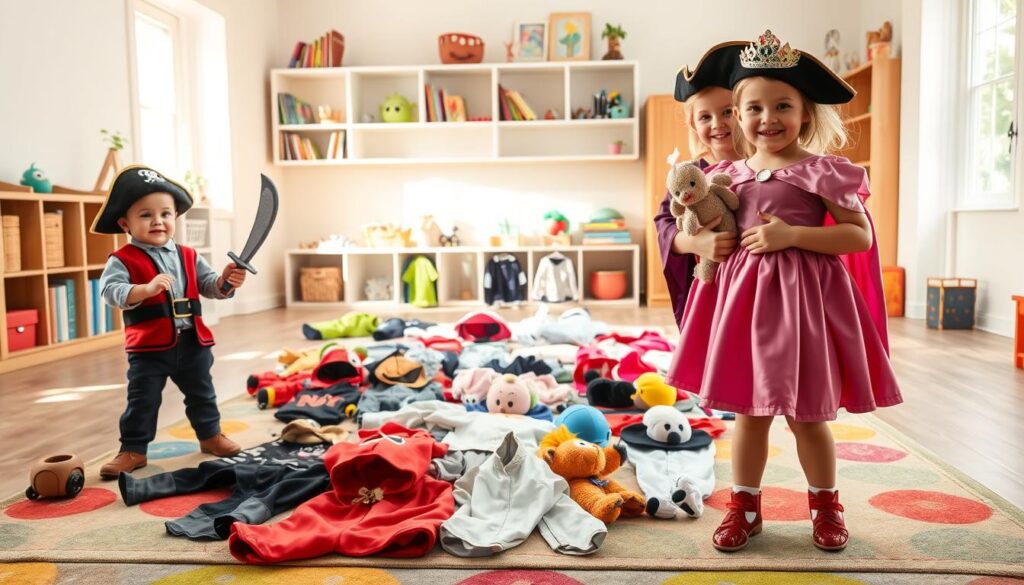
But there’s more to it than just safety. We also need to let kids try out different roles without judgment. This means not limiting them to certain roles based on their gender. It’s about giving them the chance to learn and grow.
When kids play different roles, it’s not a problem. It’s actually a sign of their creativity and ability to think differently. It’s about letting them explore and learn without limits.
To make this work, we need to change how we think about rules. Instead of just saying no, we should encourage kids to think for themselves. This means creating a space where they can try new things and learn from their mistakes.
Here’s how we can do this:
| The Old Playbook (Restrictive) | The New Protocol (Empowering) |
|---|---|
| “That costume is for the other gender.” | “All roles are open for exploration. What does this character do?” |
| Props are exact replicas; play must be “correct.” | Props are open-ended tools; a spoon can be a scepter, a microphone, or a magic wand. |
| Focus on the final “look” and costume accuracy. | Focus on the narrative, problem-solving, and emotional journey of the role. |
| Safety means only physical hazard removal. | Safe dress-up means physical safety plus psychological safety to explore without judgment. |
Our goal is to create a safe and open space for play. Think of your home as a place where kids can explore and learn. It’s a place where they can ask “What happens if…?” and discover new things.
Creating a safe space means more than just avoiding dangers. It means creating a place where kids can be themselves and explore without fear of judgment. It’s about letting them tell their own stories and try new things.
In the end, setting boundaries for safe play is like guiding a car on a winding road. It’s not about stopping the journey; it’s about making it safe and exciting. By focusing on both safety and freedom, we can help kids grow and explore in a safe and supportive environment.
Supervision guidelines
Forget the warden. You’re now a documentary filmmaker and stage manager for a fun, non-union show. Your main task is to watch and learn. Your child’s creativity is the main attraction. You’re there to observe and note the stories they create with their carefully chosen gear details and other safe dress-up ideas.
Next, you become a supporting actor. You’re allowed to join in the play. If they’re running a café, you can order something. This adds a new element to their play, making it more interesting without taking over.
Your role is to keep things safe while adding complexity. Make sure the blanket fort stays upright. Your goal is to be present but not controlling. You can introduce new ideas, then step back. Let them keep telling their story. This way, you help turn simple dress-up into exciting adventures.